Operational timelines on large concrete placements demand continuous mechanical finishing before the initial set window expires. A ride-on power trowel covers 4 to 5 times the surface area of a walk-behind unit per…
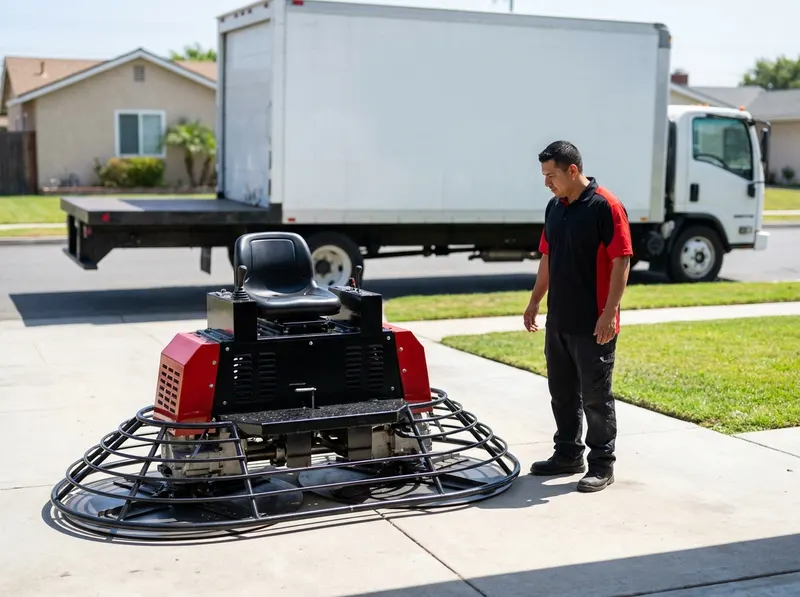
Operational timelines on large concrete placements demand continuous mechanical finishing before the initial set window expires. A ride-on power trowel covers 4 to 5 times the surface area of a walk-behind unit per hour, making it the required choice for placements exceeding 5,000 square feet. For residential garage additions or utility pads under 2,000 square feet, a 36-inch walk-behind trowel remains the practical alternative due to tight turn radiuses; however, the trade-off is extended operator fatigue and longer finishing cycles that risk crusting the top paste under Orange County heat. A non-overlapping 36-inch twin trowel spans an operating width of roughly 78 inches, whereas a 46-inch heavy-duty overlapping machine spans over 95 inches, demanding dedicated trailer access and clear site approaches.
Staging high-output finishing equipment in Anaheim requires exact spatial and environmental planning. Commercial warehouse developments around the Platinum Triangle and industrial projects along West Anaheim necessitate high F-min floor specs where panning and finish passes must occur sequentially within strict cure windows. In historic sections like The Colony or hillside residential builds near Anaheim Hills, access routes feature narrower street parking and restricted grades that require coordinated drop-offs via tilt-bed transport. The Santa Ana wind conditions blowing through Canyon City and the Santa Ana River basin accelerate surface dehydration on exposed slabs, requiring immediate blade engagement as soon as foot pressure leaves less than a 1/4-inch indentation.
Jobsite readiness follows a three-step intake sequence: Step 1 involves measuring gate clearances and slab approach paths to confirm a minimum 8-foot operational corridor for machine placement. Step 2 requires matching blade configuration, such as clip-on float blades, float pans, or flat-finish steel blades, to the engineer's specified concrete mix design and chemical hardener schedule. Step 3 concludes with on-site fuel verification and pitch control testing before the concrete trucks discharge their initial yardage.
Every job gets a firm, written price after a free on-site visit.
Tell us about your ride-on power trowel rentals job in Anaheim and we'll send a clear, written quote, usually the same day.
 Precision Dumpster Rental